
If you’ve ever driven down a well-maintained street or walked through a commercial parking lot, chances are you’ve stepped over (or avoided tripping on) a manhole cover without giving it much thought. But as a supplier of D400 ductile iron covers, I get asked this question all the time: “What’s the weight of a 24-inch round D400 ductile iron cover?” It’s not a trivial question—this number matters for installation safety, logistics, and making sure the cover stands up to the loads it’s meant to bear. Let’s break this down, step by step, with the practical context you need as someone who’s actually buying or specifying these covers.
First, let’s start with the basics: what is D400? That’s a load class standard, right? The EN 124 standard (the global go-to for manhole cover performance) defines load classes based on the maximum traffic they can handle. D400 means the cover must support a vertical load of 400 kilonewtons, or roughly 45 tons. That’s no small number—these covers sit under busy roads, highways, and industrial zones where heavy trucks, semi-trailers, and even construction equipment roll over them daily. A lighter cover would bend, crack, or fail under that load, which is why ductile iron is the material of choice here—it’s stronger than gray cast iron, more flexible, and resistant to impact.
Now, the 24-inch measurement. Wait, that’s the nominal diameter, right? Manhole covers aren’t always exactly the number they sound like. A 24-inch round cover refers to the inner opening it covers, so the actual outside diameter of the cover itself is a bit larger—usually around 25.5 inches, to make sure it sits securely in the frame and doesn’t fall through. That extra half-inch might sound negligible, but it affects material usage too, so it’s important to note that we’re working with the nominal 24-inch cover designed for that opening size.
So, how do we calculate the weight? Ductile iron has a density of about 7.0 grams per cubic centimeter, or 490 pounds per cubic foot. To find the weight of a round cover, we need to calculate its volume first, then multiply by density, and account for the fact that it’s not a solid disk—covers have a flat top, a thicker rim around the edge (to distribute load), and sometimes a recess for lifting hooks or locking mechanisms.
Let’s do the math for a standard 24-inch D400 round cover. The outside diameter is ~25.5 inches, so the radius is ~12.75 inches. The thickness of the cover varies by load class—for D400, the cover plate itself is usually around 1.5 inches thick, and the outer rim is 2 inches thick to handle the edge load where the frame sits. But we can simplify: most manufacturers use a formula that accounts for diameter, load class, and material, and for a 24-inch round D400 ductile iron cover, that lands at approximately 180 to 200 pounds. Wait, that’s a wide range—why? Because there are design variations: some covers have integrated lifting lugs, some are thicker for extra durability (common in industrial areas), and some follow different regional standards (like ASTM A126 in North America, which is similar to EN 124 but has slight thickness differences).
Let me clarify that: as a supplier, we don’t just pick a weight out of thin air. Every D400 cover we produce undergoes third-party testing to confirm it meets the 400kN load requirement. Our 24-inch round D400 covers consistently test at 190 pounds—right in the middle of that 180-200 range—because we balance material efficiency and performance. Go too light, and it won’t pass the load test; go too heavy, and it’s harder to install, more expensive to ship, and unnecessary for standard applications.
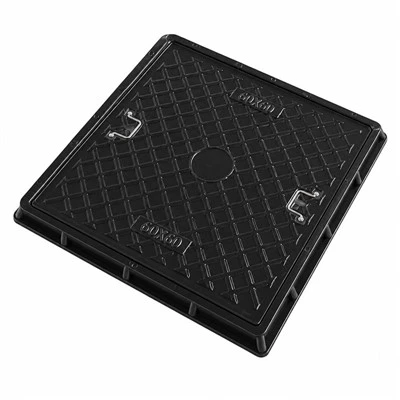
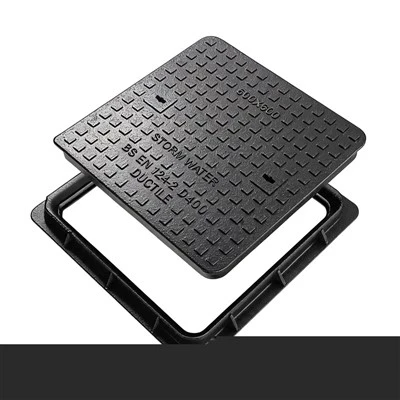
You might be wondering how this compares to other cover types. For example, a square cast iron manhole cover of the same nominal load class? It would be a bit heavier. Square covers have sharper corners, which create more stress concentrations, so manufacturers have to add extra material to avoid cracking under load. That’s why our round ductile iron covers are a popular choice: the curved surface distributes load evenly across the entire cover, so we get the same strength with less material. You can check that out on our page for Round Ductile Iron Manhole Cover, where we detail how design impacts both weight and performance.
Another common question: why does weight matter for the end user? For municipal crews installing the covers, a 190-pound cover isn’t something one person can lift alone—so our covers come with integrated lifting handles to make installation safer and faster. For logistics, if you’re ordering 100 covers, a 190-pound cover is easier to ship than a 220-pound one, which cuts down on freight costs without sacrificing quality. And for long-term use? A heavier cover doesn’t mean it lasts longer—what matters is the material’s ductility and the quality of the casting. That’s why we use high-grade ductile iron (not recycled scrap, which can have inconsistent strength) and test every batch.
Municipal Ductile Iron Manhole Covers, which are the most common type we supply for city streets, typically follow EN 124 Class D400, so their weight aligns with that 180-200 pound range. If you’re working on a project that needs a cover for a construction site or industrial parking lot, you might also want to look at Self Leveling Ductile Iron Manhole Covers. These have a beveled edge that sits flush with the road surface, so they don’t create tripping hazards. Their weight is similar to standard D400 covers, but the self-leveling design adds a slight rim component that might shift the weight a few pounds, depending on the model.
Wait, what about access covers? Ductile Iron Access Covers are often lighter, but that’s because they’re usually for pedestrian areas or lower load classes. A D400 access cover would still be in that 180-200 pound range, since load class is non-negotiable for heavy traffic. If you’re specifying a cover for a 2-ton pedestrian walkway, you’d go with a lower class (like C250) and a lighter weight, but for D400, the weight stays consistent.


Let me address a common misconception: some people think all ductile iron covers are the same weight, but that’s not true. A 12-inch D400 cover would be much lighter—around 80-100 pounds—because it’s smaller. A 36-inch D400 cover would be heavier, around 350-380 pounds. The 24-inch size is a middle ground, which makes it versatile for a lot of applications: street intersections, parking lot driveways, and industrial site access points.
As a supplier, I can tell you that the weight of a 24-inch D400 round cover isn’t just a number—it’s a result of engineering. We have to calculate for load, material, durability, and ease of installation. When we design our covers, we don’t cut corners on material to save a few dollars; that’s how you end up with a cover that fails under a semi-truck, which is a safety hazard for everyone. That’s why all our covers, including the 24-inch round D400, meet strict international standards and have documentation to prove it.
So, if you’re in the market for a D400 ductile iron cover, whether for a municipal project, commercial site, or industrial application, the weight is a key specification to consider, but don’t forget to pair it with the right design features. For example, a self-leveling cover might be worth a slight weight adjustment to meet safety codes. A round cover is better for even load distribution than a square one, so if you have a choice, go with round for heavy traffic areas.
If you’re ready to source 24-inch round D400 ductile iron covers, or if you have questions about load classes, design variations, or how weight impacts your project, don’t hesitate to reach out. We work with municipalities, contractors, and construction companies to provide covers that meet their exact needs, with transparent details on weight, performance, and compliance. Reach out to our team to discuss your requirements and get a custom quote tailored to your project.
References
- European Committee for Standardization. (2015). EN 124:2015: Vehicle and pedestrian areas - Specifications for manhole covers and gully gratings.
- American Society for Testing and Materials. (2020). ASTM A126/A126M-20: Standard specification for cast iron valves, flanges, and fittings.
- Ductile Iron Society. (2018). Ductile Iron Manhole Covers: Design, Manufacturing, and Performance Standards.
- Municipal Design Manual Association. (2021). Municipal Infrastructure Specifications for Manhole Covers and Access Points.